Instagram Leads: How to Build Reels, Series and Content by Industry
A reel can have two jobs. One is to grow the page: reach new people, gather followers, get passed along. The other is to bring in an enquiry, meaning a private message, a requested offer, a booking or a call. It rarely does both at the same time, and accounts that expect leads from clips made for reach end up wondering where the clients went.
This article follows how a reel that does its job is built, how clips are linked into a series and how the work is divided between them, by industry. It is the third in a series on reels in 2026: the first explains what the Instagram algorithm measures, the second what the research says about authentic and AI-generated content.
Four moments that decide the fate of a reel
A successful clip is built in four moments. The first is the opening, because this is where most of the audience is lost. Next comes pacing, then how the clip is understood without sound and, at the end, the reason someone sends it on.
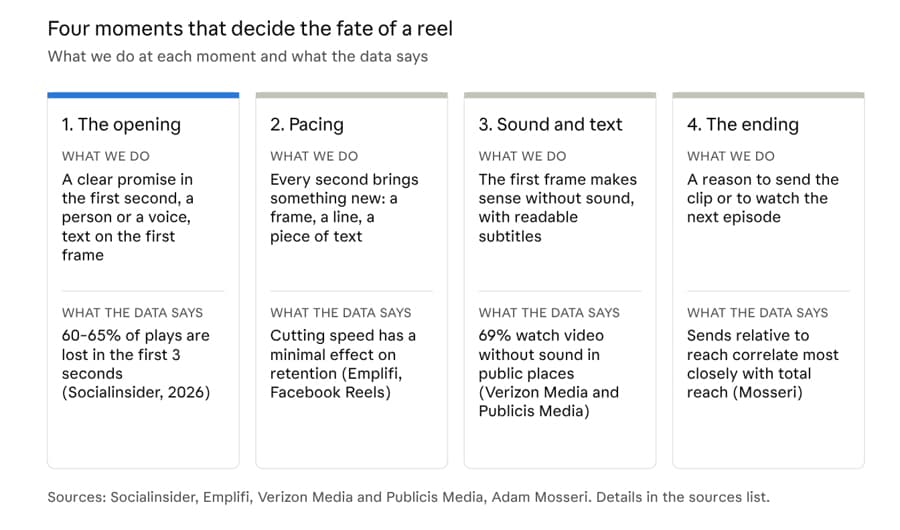
Four moments that decide the fate of a reel: what we do and what the data says
The opening. Between 60% and 65% of plays are lost in the first three seconds, according to the Socialinsider analysis cited in the article on the algorithm. The first second has to say what the clip is about, and the second has to give a reason to stay. In practice, the openings that hold an audience fall into a few forms: a question asked directly, the result shown before the process, an unexpected detail from a familiar place, a figure or a price said out loud. This is a working classification from Mapped, built from production practice, and it remains to be tested on each account. Instagram has shown the skip rate in Insights since 2025, the share of viewers who leave in the first three seconds, which allows a simple test: change only the opening and compare.
Pacing. A clip’s dynamics come down to the pace of information: every second should bring something new, whether a frame, a line or a piece of text. In its analysis of 10,110 Facebook Reels, Emplifi found that cutting speed has a minimal effect on retention. In our reading, a long shot holds attention if something happens in it, and ten cuts do not help if nothing does.
Sound and text. Many people watch without sound. An older Verizon Media and Publicis Media study of 5,616 US consumers found that 69% watch video without sound in public places, and up to 80% would be more likely to finish a clip with subtitles. There is no evidence that the Instagram algorithm rewards subtitles as such, but they protect watch time. The first frame should make sense without sound: a short line on screen, a face, a gesture.
The ending. Mosseri has said that sends relative to reach correlate, in his experience, more than any other signal with overall reach, because the platform looks for content people want to discuss with friends. A clip is sent when it speaks to a specific person: a surprising price, a place to see at the weekend, an explanation you know who to pass on to. The last second should offer that reason or announce the next episode. For very short clips, Emplifi shows that a seamless loop, where the end connects to the beginning, can raise replays and reach.
From isolated clip to series
An isolated reel gets one chance, in the seconds it lasts. A recurring format, with a name, the same structure and the same people, changes the rule, because the second episode builds on the first. Psychology calls the mechanism the mere-exposure effect: what we see more often becomes familiar, and the familiar inspires more trust. Platforms seem to follow the same logic. Meta is testing, according to TechCrunch and Gulf News, a “Series” feature that links reels into episodes, so that the viewer moves from one clip to the next without leaving the sequence. The stated aim is to keep people watching longer, and the feature is still in testing with selected creators, with no published figures on usage or retention.
Spectacular figures on series retention circulate on the blogs of scheduling tools. We left them aside, because they come from internal analyses and cannot be verified. Mapped’s argument is simpler: a series turns a content idea into an expectation on the viewer’s side, and expectation brings back people an isolated clip never sees again. The format suits any field with something to explain or follow: “Question of the Month” at an accounting practice, “A Morning at Reception” at a hotel, “Before and After” at a workshop, “The Real Price” at a shop.
The person on camera in a clip that has to sell
The studies in the previous article translate, for a clip that has to bring in leads, into four gestures. The person appears from the first seconds, because speech and a face in the opening hold an audience better than music alone. The person does something on camera, since in Virlo’s data action outperformed the monologue to camera. The same person returns in every episode, and that recognition builds the trust you buy at a hotel, a clinic or a practice. The person states their name and role, on screen or in the first line, so the viewer knows who is speaking. At Horizon by Aro Palace, a restaurant Mapped manages, a reel in dialogue between the chef and the F&B manager performed better than other reels with food, people in the restaurant or events, because the interaction was natural and funny. On our accounts, funny and creative dialogues have worked within the limits of the client’s brand image, premium included. Worth comparing on your account too: two series of four episodes each, one with dialogue and one with monologue, are enough for a first comparison.
What grows the page and what brings leads
A page grows from reach to new people, follows and sends. A lead appears in a private message, an offer request, a booking or a call. The 2026 HubSpot report, based on more than 600 Instagram marketers, shows both sides: product and service content (demos, teasers) is named as the main source of engagement and ROI by 46% to 54% of respondents, depending on the section of the report, while 36% say an overly commercial tone has cost them followers.
The practical solution is the offer delivered in the same tone as the rest of the content: filmed by the same people, with a price, a date range or an availability stated directly, in a clip that has value even without the offer. The next step is a keyword people reply with in a private message, which in our reading moves the enquiry to a place where it can be qualified, with questions and availability, without the pressure of a form.
Cases from Mapped’s practice
The Rubber Duck Race reel, on the Brașov Travel page managed by Mapped for OMD Brașov, brought 6,776 follows from 15,383 profile visits, which is 44%. The audience comes from a moment, and the community is built from the episodes that follow. The case is detailed in the article on the algorithm.
At the Horizon by Aro Palace restaurant, a campaign with content creators, supported by paid promotion, took Instagram views to 273,000 in February, 757% above January. Of those views, 93% came from accounts that did not follow the page, and the page gained 1,186 new followers. Reels produced 64.8% of the views in the 30-day period between 7 February and 8 March. The campaign therefore worked on reach, with new people, and reels did the heavy lifting.
On Brașov Travel, content is mixed by task: people and place for trust, the moment (an event, the first snowfall, a weekend’s weather) for coverage, and offers have their own place, said in the same tone.
Benchmarks and account size
Benchmark figures do not give a reliable ranking between industries, because each study measures a different sample. Dash Social finds reels engagement of 0.5% for travel and 0.1% for home and fashion. Socialinsider, on a different data set, shows 0.38% for hospitality, 0.23% for restaurants and cafés, 0.20% for travel and 0.05% for e-commerce, as in the chart below.
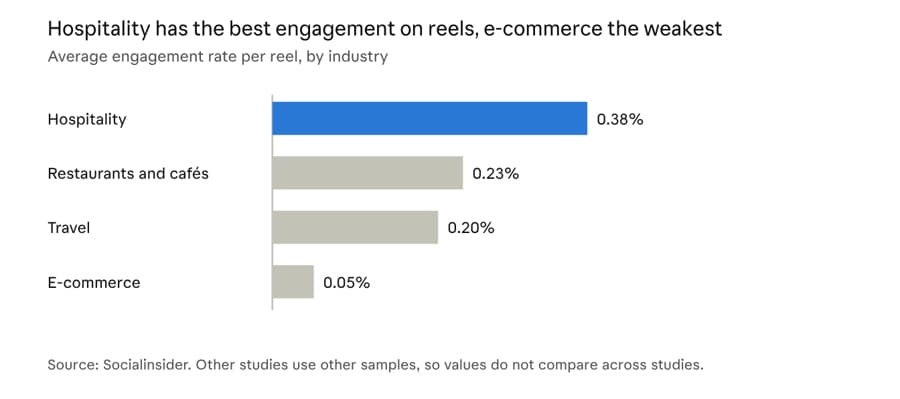
Average reels engagement by industry, Socialinsider
Account size changes the format: Socialinsider finds the best reach from reels for accounts under 50,000 followers, while above that size carousels lead. A small account therefore has one more reason to make reels, and a large one to complement them with carousels.
The industry grid
The grid below is Mapped’s recommendation, built on the data in the articles of the series and on our cases.
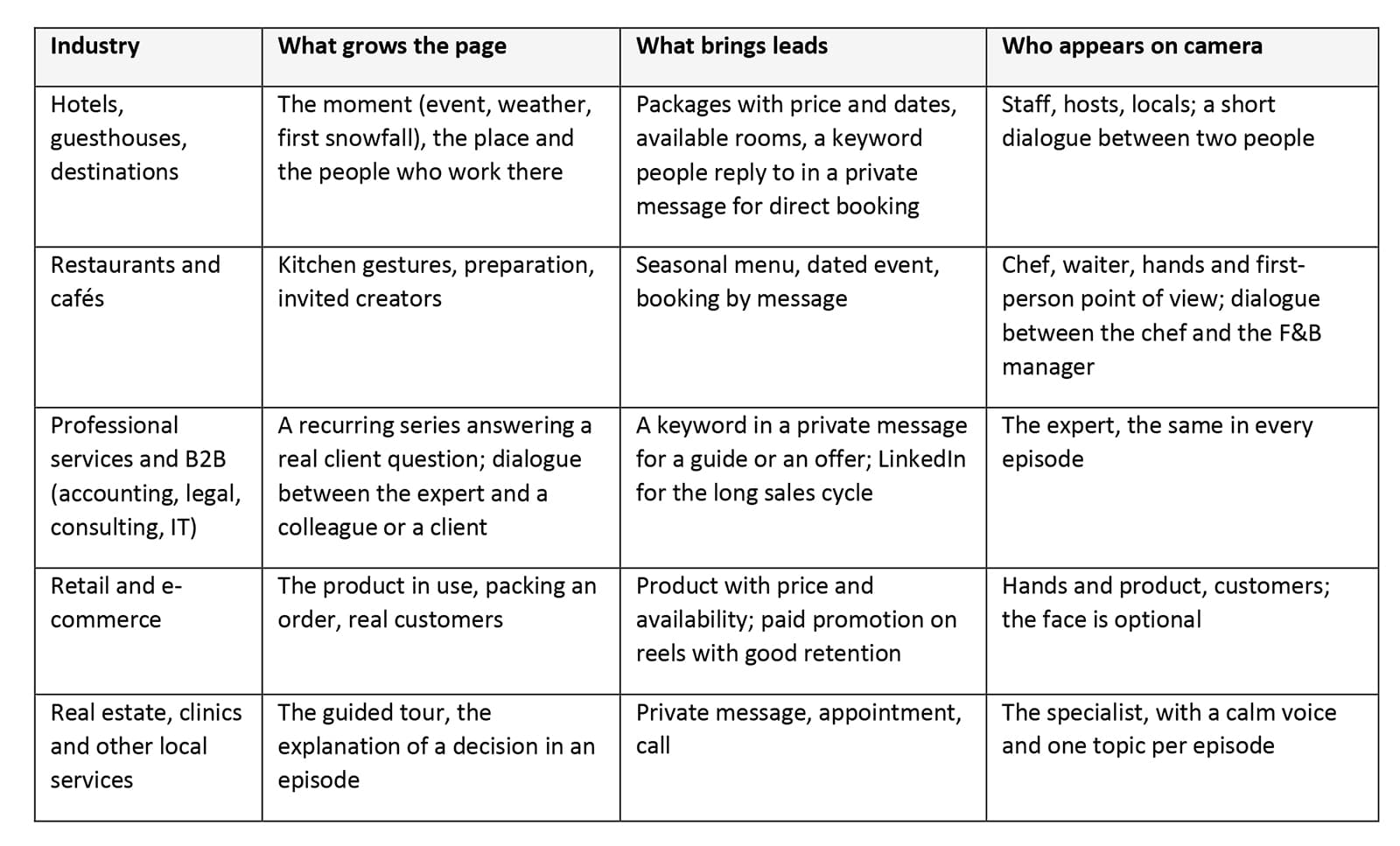
How we choose for each clip
Three questions are enough to decide a clip. What is its task: to be seen by new people, to build trust or to bring in an enquiry? What does the person on camera do in the first three seconds, because that is where the play is lost or won? What comes after the clip: an episode, an offer, a keyword people can reply to in a private message? A reel with no answer to the third question can be a views success and still have no follow-up.
The short, catchy reel remains the opening. The series, the person on camera and the offer said in the same tone build what remains after it, and each industry picks the proportion by its own numbers.
Sources
- Rubber Duck Race and Horizon by Aro Palace data: Instagram insights for the Brașov Travel and Horizon by Aro Palace pages, from the Mapped The Agency presentation (November 2026).
- Opening, pacing and person on camera: Emplifi, Facebook Reels data, Social Media Today, the Emplifi study, Metricool, skip rate and retention on Instagram and Virlo, faceless content.
- Sound and subtitles: Kapwing, subtitle statistics (after Verizon Media and Publicis Media) and Buildmyplays, subtitles on Instagram.
- Sends: Social Media Today, Mosseri’s statements on sends.
- Series: Gulf News, the Series feature (after TechCrunch).
- Balance with the offer: HubSpot, Instagram report 2026.
- Benchmarks: Dash Social, reels benchmarks by industry and Socialinsider, reels statistics 2026.