Authentic or AI-Generated Content? What the Research Says and How to Choose in 2026
2026 began with a statement that moved the conversation from marketing to psychology. Adam Mosseri wrote that Instagram’s polished feed has had its day. According to reports of his message, a flawless image is worth less and less when AI can produce it in seconds, and authenticity itself can be imitated by anyone. What remains valuable is what only you can create.
For a business that pays for content, the questions are practical. Why does the eye skip over a polished layout? How much trust is lost when people suspect an ad was made with AI? Does a person on camera help and, if so, what should that person be doing? Below we gather what the research published so far says, and what is left to test on each account.
Why the eye skips what looks like an ad
People have learned to recognise advertising at a glance. In a study in Frontiers in Psychology (2025), 152 participants scrolled a simulated Instagram feed while their gaze was tracked. Sponsored posts received about 25% fewer fixations than organic ones: the eye took in the polished image, the logo and the “shop now” button before reaching the ad label. For ads integrated into the feed, with less polished visuals, this happened less often. The sample is small, with an average age of 25, so the result indicates a direction.
Researchers call the mechanism persuasion knowledge: once an ad is recognised, the defences switch on. In an experiment published in the International Journal of Advertising, user-created posts bypassed this defence and produced higher purchase intent among young adults than declared ads and brand posts.
In our reading, something else is at work. When any layout can be generated in seconds, polish no longer proves an investment and ends up working as an ad signal. A less polished look helps when the clip shows something that truly belongs to the account publishing it.
AI or real people: what the research shows
In a Harris Poll survey for 4As and Infillion (2026), 73% of respondents said they would trust an ad less if they suspected it was made with AI, 63% said they would buy less often from a brand that uses such ads, and 78% said AI makes ads feel less authentic.
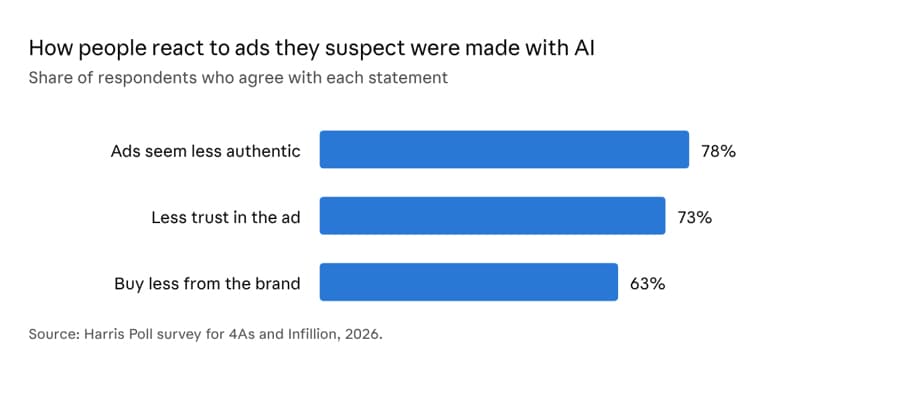
How people react to ads suspected of being made with AI, Harris Poll for 4As and Infillion, 2026
NielsenIQ measured the reaction directly, with electroencephalography: in a study of more than 2,000 participants (EEG on about 150), AI-generated video ads were experienced as more annoying, more boring and more confusing than conventional ones, and memory activation was weaker even for the better-quality versions.
For services sold on trust, the evidence is finer. Researchers at Washington State University showed, in the International Journal of Hospitality Management, that disclosing the use of AI lowers trust in services built on emotional connection and luxury, such as a restaurant recommendation, and matters little for functional ones, such as check-in. The study concerns hospitality; extending it to other domains with an emotional component is our reading.
The evidence does not all point the same way, though. An experimental study published in a SAGE journal found higher average scores for AI-generated tourism images than for real ones on credibility, authenticity and intention to visit, with smaller differences among younger participants. According to TravelPulse, in a Talker Research test only one in four participants correctly identified the real photo in a pair of destination images.
The two sets fit into one reading: people do not always recognise AI-generated content, and trust drops the moment they discover or suspect it. For anyone selling a place, a team or expertise, the promise in the clip has to be found exactly as shown at the real encounter.
The person on camera: dialogue, monologue or a clip without a face
On the person on camera, the data is more nuanced than usually claimed. Emplifi analysed 10,110 Facebook Reels from 704 brand pages. Human speech in the first three seconds raised 10-second retention by almost 25% compared with music, and a person appearing for at least one second in the first three added about 10% more. The advantage thins out over time: 30-second views fell by 2.4% for clips with a person. Speech-led clips had 5.6% more engagement than music-led ones.
On Instagram, Virlo compared 31,915 reels published between 1 October and 5 November 2026 with similar clips by age and follower count. Faceless reels received 1.00 of typical views and reels with a face 0.97, a small difference. The ranking by style says more, and the chart below shows it: talking to the camera, the most common format (44.3% of the sample), sits lowest, while a person doing something on camera, without a speech, sits highest. The sample is not representative of all reels, and the result shows an association, with causation still to be shown.
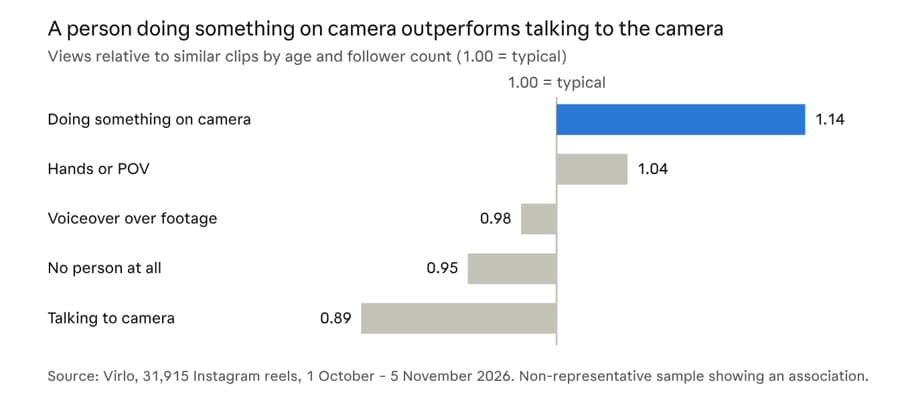
Views by clip style relative to similar clips (1.00 = typical), Virlo, 2026
No study we found tests dialogue as such, but what the research shows fits what we have seen on the accounts we manage: a person helps most when doing something and speaking naturally. Dialogue combines exactly those ingredients: speech from the first seconds, two people on camera and an action, meaning one asks and the other answers. The clearest example comes from Horizon by Aro Palace, a restaurant Mapped manages: a reel in dialogue between the chef and the F&B manager performed better than other reels featuring food, people in the restaurant or events, because the interaction was natural and funny. Funny, creative dialogues have worked the same way on other accounts, on one condition: the tone stays within the client’s brand image. For a premium brand, humour is dosed with more care and can work just as well when it comes in the brand’s voice. This is an observation from our practice, with no published figure behind it. The faceless clip has its place where the product speaks for itself: kitchen gestures, a product in use, a place with a voiceover. Where trust is the product, in accommodation, professional services or clinics, a person who returns in every episode becomes the reason people come back.
What we take away
The data settles into a working rule. AI does its work behind the camera: ideas, draft copy, translations, editing. In front of the camera stay the people and the place, where a business’s promise is verified at the real encounter. Polish remains useful for what lives long, such as the website, the presentation of a place or a paid campaign, while the clip in the feed wins through its opening and through something only the publishing account can show. What follows once people sense that an account is authentic, meaning series, offers and leads, comes in the next article.
Sources
- Mosseri’s message of 1 January 2026: Betanews and Nation Thailand.
- Attention and advertising: Frontiers in Psychology, 2025, Frontiers, news release and International Journal of Advertising, user-generated content.
- AI-generated content: 4As, Harris Poll and Infillion, NielsenIQ, Washington State University, hospitality, SAGE study on tourism images and TravelPulse, Talker Research.
- Person on camera: Social Media Today, the Emplifi study on speech and human presence and Virlo, faceless content.