Instagram's Algorithm in 2026: What Matters Now for a Business Account
The question comes up in nearly every strategy meeting: do short, catchy reels still work, the ones with a trending sound and a first three seconds built to stop the thumb? The answer lies in how Instagram decides what to show next. The platform does not announce “algorithm updates” with a date and a version number, but it does announce features and policies, and from those, together with Adam Mosseri’s statements, it is possible to reconstruct fairly clearly what it measures in 2026.
The 2026 data answers in two parts. A short clip remains a very good way in for a small account, but on its own it builds nothing that lasts once the viewing is over. We go through what Instagram measures, how long a reel should be and what is changing in the rules, then read a Mapped case, the Rubber Duck Race (Cursa cu Rățuște), against those numbers. The next articles in the series take up two further questions: why people react differently to authentic, polished or AI-generated content, and how a growing account turns into one that brings in enquiries.
What Instagram measures, in the words of the people who run it
Adam Mosseri, the head of Instagram, has named three main signals for ranking reels: watch time, likes relative to reach, and sends by private message relative to reach. According to reports of his statements, likes weigh more for people who already follow you, and sends for people who do not know you yet. Comments are not on the list. A clip climbs when it is watched all the way through and when someone feels like sending it to a friend.
The first three seconds
The first test happens in the opening seconds. In a Socialinsider analysis of almost 9.8 million brand reels published between January and June 2026, between 60% and 65% of plays were abandoned in the first three seconds, with the share falling as the account grows. This is where the catchy clip earns its place: an opening that stops the thumb. A trending sound and a brisk edit are good tools for that, with one condition: there has to be something behind the opening.
How long a reel should be
The same data set shows the best reach rate for reels of 30 to 60 seconds (5.60%), followed by those of 60 to 90 seconds (5.30%) and those under 30 seconds (5.20%). Above 120 seconds the rate falls to 3.50%. Instagram now allows longer clips, but its own recommendations point the other way: in 2025 it advised against posting reels longer than three minutes, and a year earlier it had warned that those over 90 seconds can affect distribution.
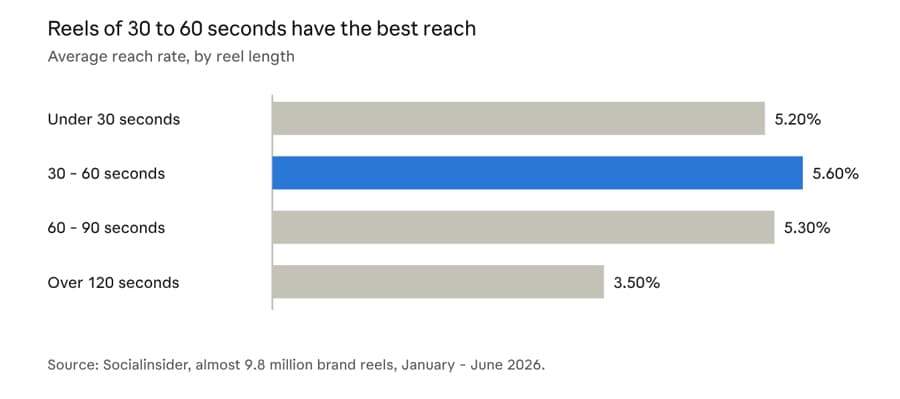
Reach rate by reel length, Socialinsider, January – June 2026
A more crowded field, with new rules
The 2026 Metricool study, covering more than 24 million posts, shows that brands published almost 35% more reels in January and February 2026 than in the same months of 2025, while the average watch time of a reel reached 8.5 seconds, more than double the year before. With that many clips on the same screen, the opening has to be won again on every scroll.
Platform policies point in the same direction. Reels are first tested on a small audience, and those that do well reach progressively wider ones. From 30 April 2026, the rule applied to reels since 2024 extends to photos and carousels: accounts that mainly publish unmodified reposted content disappear from recommendations. According to reports, improving ranking by originality is among the priorities Mosseri listed for 2026.
The “Your Algorithm” feature, launched for reels in December 2025, reached the main feed in June 2026: users choose their topics, and clips from removed topics are shown less, regardless of engagement. For testing, Mosseri recommends Trial Reels, where a clip shown first to an audience that does not follow you can be published widely if it performs well. One practical consequence follows from these rules: an account that talks about wine one day, fitness the next and accounting the day after is hard to place in a topic, while one with a clear thread is easy to recommend.
The Rubber Duck Race, read through watch time
The Brașov Travel page, managed by Mapped for OMD Brașov, had only just started publishing when the Rubber Duck Race took place, a charity event raising funds to equip the Oncology Department of the Brașov Emergency Clinical Hospital for Children. The team filmed the moment on a phone and published it right at the end of the event. Professionally filmed clips on varied topics were being published on the page at the same time.
The reel is 39 seconds long, which falls within the 30 to 60 second range where Socialinsider finds the best reach. Insights shows 31,375,055 views across 24,335,629 accounts and an average watch time of 19 seconds, almost half the duration. Those 19 seconds are, naturally, the first part of the clip, the one where the event is clearest. The average reel in 2026 runs 8.5 seconds, according to Metricool, from a different data set.
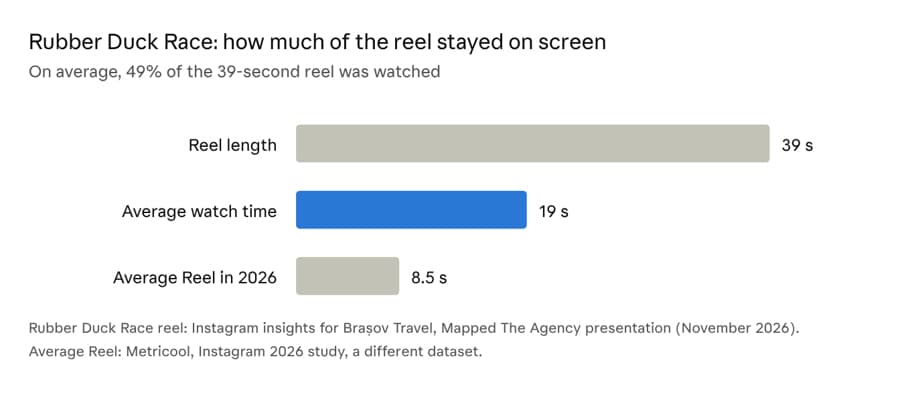
Rubber Duck Race: reel length, average watch time and the 2026 average reel
The clip received 235,968 likes, 8,051 saves and 6,080 reshares. Of 15,383 profile visits, 6,776 became follows, which is 44%. The three signals Instagram names as main ones, watch time, likes and sends, all appear here at large scale: a short clip with a clear opening was watched to a good length and passed along by people.
Two months after publication, the reel still brings in followers and likes. The page also grows thanks to the other type of content, the professionally filmed and varied clips, and thanks to the mix between the two, which follows a content strategy built on series and recurring formats.
The following articles start from this mix: what the research says about authentic content, and how a huge audience turns into a community that brings in enquiries.
The short answer: do short, catchy reels still work?
They do, as an opening. The 30 to 60 second range has the best reach, and the first three seconds decide whether the clip still has an audience. As the foundation of an account, a short reel falls short: the market publishes more clips than before, the platform rewards the original, and people choose their own topics. The foundation is built from what comes after the clip, meaning the content mix and the series, which is what the next articles cover.
Sources
- Rubber Duck Race data: Instagram insights for the Brașov Travel page, from the Mapped The Agency presentation (November 2026).
- Instagram ranking signals: Social Media Today, Adam Mosseri’s statements, Buffer, 2026 algorithm guide, Keywords Everywhere, confirmed changes and Creatorflow, Mosseri’s priorities for 2026.
- Instagram policies and features: SocialPilot, 2026 reels algorithm (Your Algorithm), Edgar, Trial Reels, Instagram Creators, 30 April 2026 and Engadget, gradual testing of reels.
- Reel length: Social Media Today, three-minute reels and Instagram’s recommendations and Social Media Today, reels over 90 seconds.
- Reels in 2026: Socialinsider, reels statistics 2026, Metricool, Instagram study 2026 and Influencer Marketing Hub, Reels statistics 2026.