You Can Rank #1 on Google and Still Lose Customers
If you’ve checked your site’s Google rankings recently and they look fine, yet your visits or inquiries have dropped, you’re not the only one noticing it.
In the United States, Google started answering questions directly, with an automatically generated summary above the classic results, back in 2024. In Europe, because of strict competition and data protection regulations, the same feature arrived much later and much more gradually, country by country. In Romania, Google introduced the first AI-assisted search experience in Romanian only a few months ago. What has already been reality for two or three years in other markets is only just beginning here. That’s exactly why it’s worth preparing now, not a year from now, once your competitors already have.
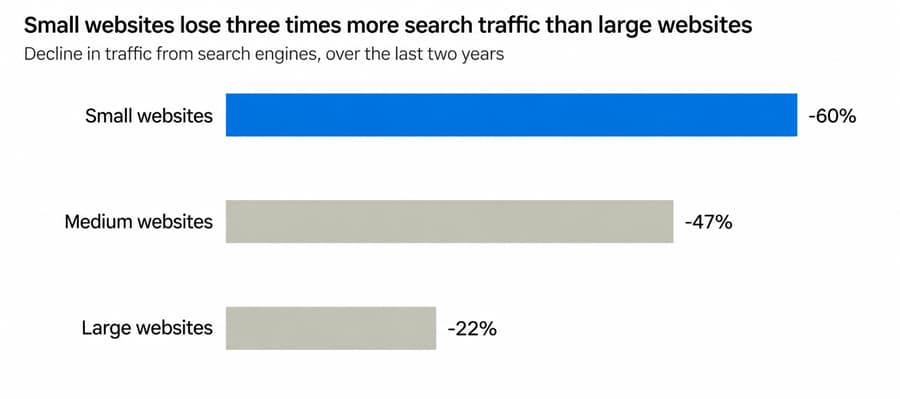
What this shift actually means: for many questions, Google gathers information from several websites and hands it to you directly, in a summary, without needing a single click on any link. International studies on markets where the feature has been active longer show organic traffic drops of 30 to 40 percent for searches where this kind of summary appears. For you, that’s not an abstract statistic, it’s a clear signal that ranking in Google, on its own, no longer guarantees visits.
What you can do about it is fairly concrete, not theoretical.
One useful habit is writing the direct answer at the start of each section, not at the end. An algorithm summarizing information usually pulls from the first lines of a paragraph, not a conclusion buried in the last sentence. If someone searches for how much a 100-guest mountain wedding costs, your page stands a much better chance of being cited if it answers with a figure or a range in the first sentence, not after three paragraphs of introduction.
The second piece is technical, though not complicated: marking up content with structured data (what developers call schema) helps search engines understand exactly what kind of information they’re looking at, a question and answer, a step in a process, an article with an author and a publish date. It’s not mandatory, but it’s the difference between a page the algorithm understands correctly and one it has to guess at.
The third, and probably the most important for a small business, comes down to what can’t be copied. An automated summary can gather general information from ten different sites, but it can’t invent a real number from your own campaign, an observation from your direct experience with guests or customers, a detail only you know because you lived it. Content that survives this shift is the kind that says something no one else can say the same way.
Freshness matters too. A page written three years ago and left untouched loses ground to one updated recently, with current figures and examples. It doesn’t need a full rewrite, but it’s worth revisiting periodically with whatever has changed since.